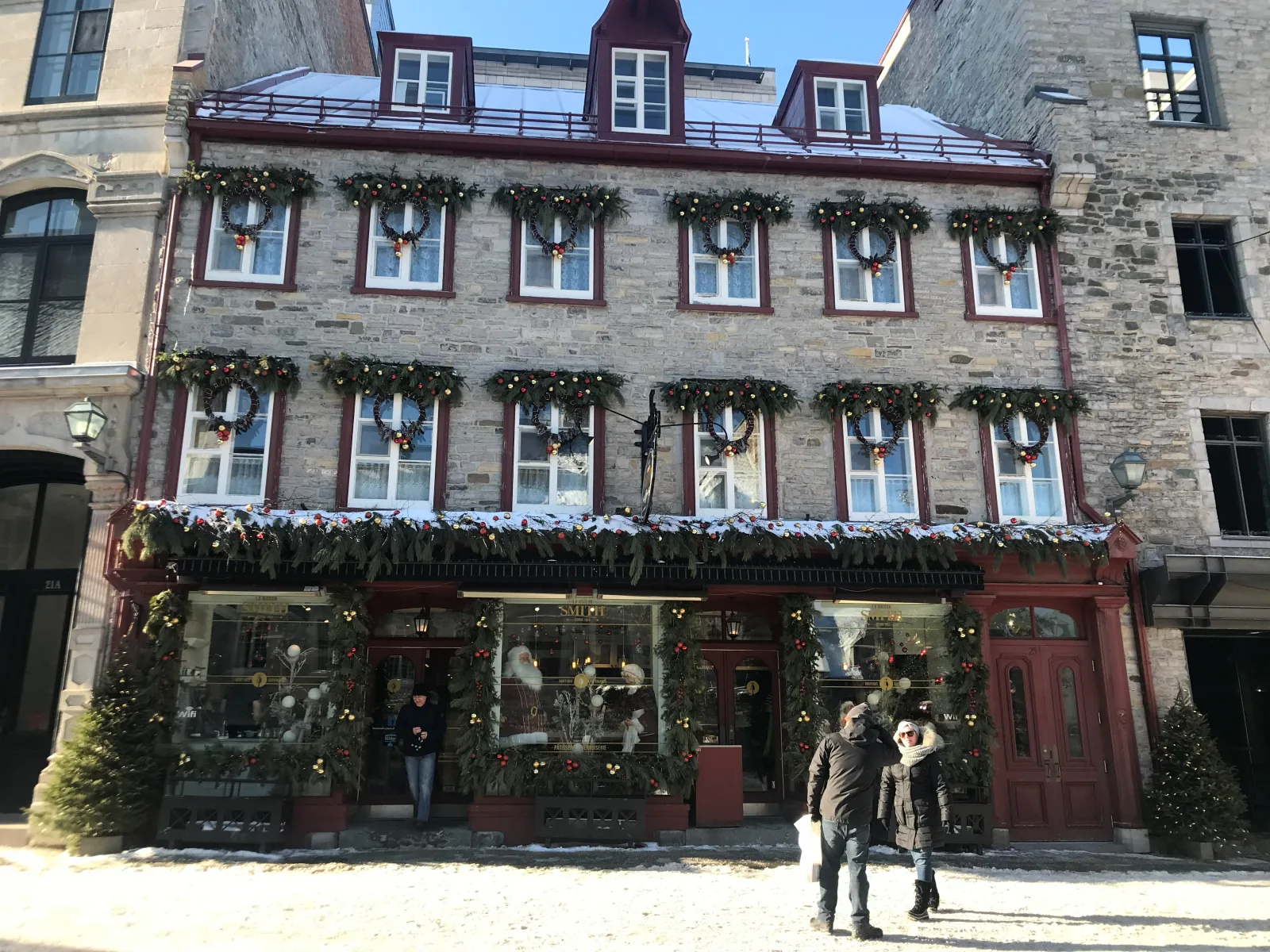
There is a version of Canada that exists before you ever go there. You assembled it young, without meaning to, from Christmas cards and snow globes and the establishing shots of holiday films, and it has certain fixed properties. The snow is always fresh. The light is always warm. Someone, somewhere, is always skating. You grow up, and you learn better, the way you learn better about most things, and you file that Canada away with the other places that were never real.
Then one December afternoon, you are standing on Rue du Petit-Champlain in Quebec City, and it is snowing, and dusk is arriving at four o’clock the way it does that far north in that season, and every shop window is lit gold against the blue of the failing light, and you realise with a small shock that you have been here before. Not this street. This feeling. You are standing inside the Canada you imagined as a child, and it turns out it was real the whole time. It was simply waiting for winter.
People think they are traveling to see snow. I thought so too, the first time. Snow was the stated reason, the thing I told friends, the thing the photographs would prove. But snow itself is only water behaving unusually, and if snow were really the point, a February parking lot would satisfy it. What you are actually traveling for is harder to name and takes longer to notice, and it begins to reveal itself in small, almost embarrassing details.
The wreaths, for instance. The stations and storefronts of a Canadian winter town are not elaborately decorated. Mostly, it is simple evergreen wreaths, some ribbon, strings of plain white lights, and this restraint is somehow the whole secret. Nothing is trying very hard. The decoration is not a production aimed at you. It is just what this place does in December, and has done, you sense, for a long time, and walking past it you feel less like a tourist attending a show and more like a stranger admitted to a ritual.
Or the hot chocolate. There is a specific pleasure available in a Canadian winter that involves nothing more than a paper cup outdoors in serious cold, and it is not really about the drink. It is the steam. It rises off the surface in a thick, extravagant column, curls past your face, and disappears over your shoulder, and every sip is preceded by this small visible proof of warmth in a cold world. I stood at the edge of a Christmas market watching steam rise off my cup and off the cup of every person around me, dozens of little chimneys in mittened hands, and I understood that I would remember this longer than most of the things I had planned to see.
The early dark helps, though no one expects it to. Dusk at four in the afternoon sounds, on paper, like a defect of the latitude. In practice, it is a gift. Darkness that arrives that early is darkness you get to be awake for, out in the streets for, and it transforms everything electric into something precious. This is not how Christmas is in Australia. Lights reflect off fresh snow in a way they reflect off nothing else, each lamp doubled and softened, whole streets underlit by their own weather. By half past four, the town has become its own Christmas card, and you are inside it, and there are still hours of evening left to spend.
So you spend them. You skate, badly, on a rink strung with fairy lights, holding the boards and laughing at yourself among small children who are frankly better than you. You watch a horse-drawn sleigh move down a street built three centuries before anyone imagined cars, the horse breathing in great white plumes, the bells doing exactly what bells do. You walk out to look at the frozen river, which does not look like water paused so much as land newly invented, and the wind coming off it finds every gap in your clothing, and you let it, because the cold is part of the arrangement. The cold is what makes everything else legible.
Because here is the transaction at the heart of all of it, the one nobody advertises. An hour outside in real winter, in air that pinches your face and stiffens your fingers inside their gloves, and then the heavy door of the hotel, and the lobby’s warmth arriving all at once as something poured over you. The smell of pine from the enormous tree. The fire is going in the fireplace, an actual fire, attended by people in armchairs who have made the same crossing you just made. Your glasses fog. Your cheeks burn pleasantly. Somewhere behind you, the door closes on the cold, and the relief runs through your whole body with an intensity that no beach, no pool, no warm-weather holiday has ever produced in me. Comfort, it turns out, is not a state. It is a contrast. Winter Canada understands this the way no other destination I know understands it, and builds its entire enchantment on the threshold between outside and in.
That is the thing I finally understood in Quebec City, somewhere between the market and the fireplace. This trip is not sightseeing. There is no list of monuments doing the heavy lifting, no single vista the whole journey funnels toward. What you are collecting is atmosphere, and atmosphere works on you the way weather works on a landscape, gradually and completely. You come home without many stories that survive the telling. It snowed. We walked around. We drank chocolat chaud and watched the skaters. Said aloud, it sounds like nothing happened. But something did happen. For a few days, you lived inside the feeling that certain places are exactly what you hoped they were, and that feeling does not fade the way itineraries fade.
The child who assembled that imaginary Canada out of cards and films was not wrong. She was early. The place holds everything she put into it, the wreaths and the sleighs and the lit windows and the deep, sound-swallowing snow, and it will hand all of it back to you the moment you arrive in December and step out into the cold. You only have to stay outside long enough to earn the warm room waiting behind the door.
The journey this essay belongs to: Across Canada by Rail