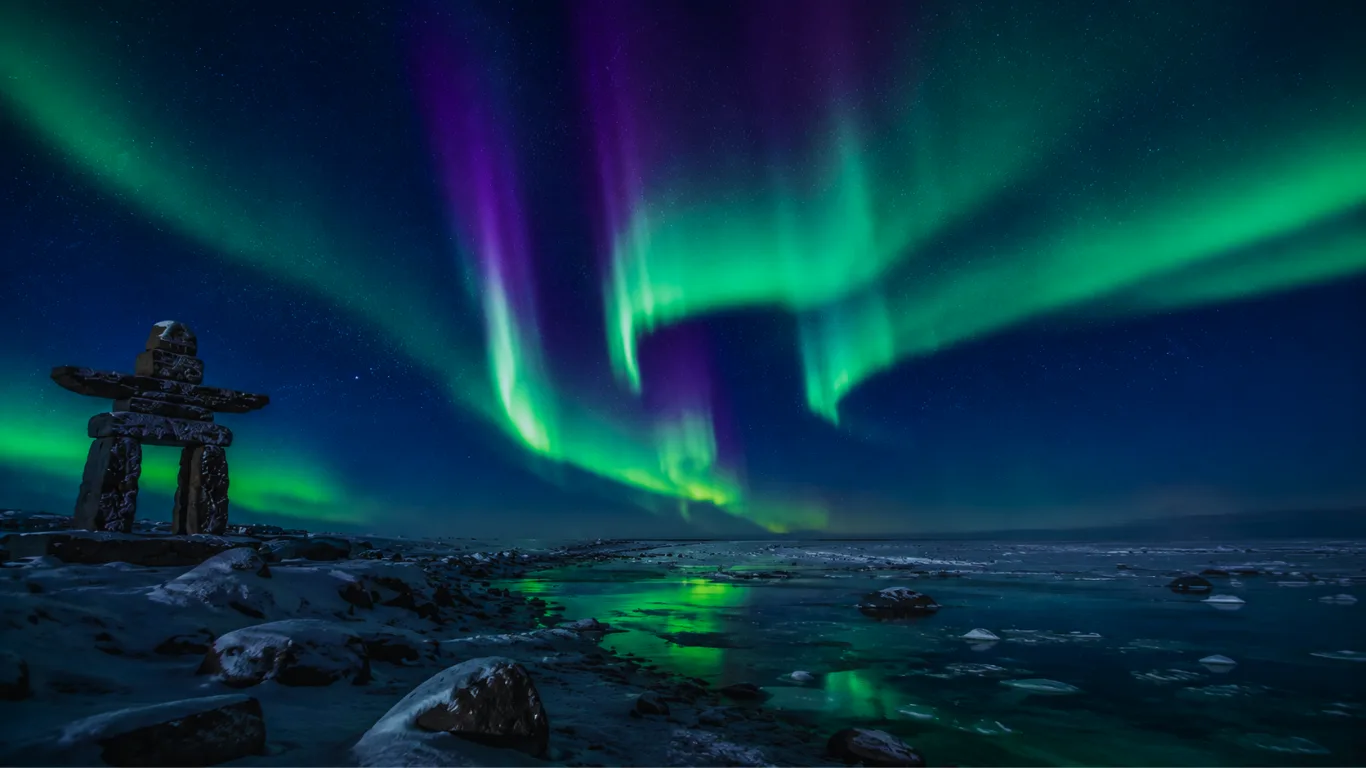
The train to Churchill takes two days out of Winnipeg, and somewhere on the second day you stop asking how much longer, because the number has stopped meaning anything useful. The towns thin out first, then the trees, then the trees give up entirely, and for long stretches there is nothing at the window but white. White as the landscape, unbroken, without a road or a rooftop or a single dark line to give the eye something to hold. I had crossed a great deal of remote country before (after all, I am Australian and we have remote vastness in droves) and always found something to anchor to. Here, there was nothing, and I remember thinking, with a mild unease that surprised me, that I had no real idea what was underneath the track anymore.
Churchill sits at the edge of Hudson Bay, on the last scrap of Manitoba before the Arctic Ocean takes over entirely, and no road reaches it. You arrive by rail or by plane, and that is the whole of your options. I had assumed, before I went, that this was a kind of exclusivity, the way a private island is exclusive, remoteness manufactured to justify the price. It isn’t that. Churchill is hard to reach for the plainer and more honest reason that it is simply very far away, from everything, in every direction. The difficulty is not a design choice. It is geography telling the truth about itself.
That distinction matters more than it sounds like it should, and it took me most of the first day to understand why. An exclusive place is remote on purpose, curated, gated, and still fundamentally organised around your arrival. A genuinely remote place is indifferent to you. It was arranged this way for its own reasons, long before you existed, and your showing up changes nothing about it. Churchill has the second kind of remoteness, the older and rarer kind, and you can feel the difference within an hour of landing.
I had not expected the journey itself to matter so much. But the two days on the train function as a kind of decompression. Civilisation does not simply switch off, replaced by wilderness, the way it might if you drove twenty minutes out of a city to a lookout. It recedes gradually, the towns thinning, the signs of people growing sparser and further apart, until at some point, and you cannot say exactly when, there is simply less of everything that tells you where you are. By the time Churchill appears, a low cluster of buildings on a vast flat shore, you have already been traveling toward absence for two full days, and the town receives you as someone who has earned the arrival rather than someone who was delivered to it. The flight home, by contrast, undoes all of it in an hour and a half, and there is something almost unsettling about how quickly the ordinary world reasserts itself once you are back in the air.
And then there is the silence, which is not the silence of the Prairies in winter, itself considerable, but something further again. Standing on the tundra outside town, with the wind down for a rare stretch, I found a quiet that had almost a physical presence, as though the emptiness of the land had a corresponding emptiness of sound. No traffic, obviously. But also no birds, no insects, none of the low ambient hum that even quiet places usually carry, and that you only notice by its absence. I said something to the guide standing next to me, and my own voice startled me, too loud, an intrusion into a place that had not asked to hear it.
The scale does something similar to your sense of yourself. The tundra does not roll or vary the way most landscapes do to keep your attention. It simply continues, flat and open, until it meets the gray line of Hudson Bay, and the bay itself continues past that into a horizon with no far shore you can imagine. Standing in the middle of it, a human being is a very small, very upright object in a very large, very level world. I have felt smallness before, in mountains, in cities, in the ordinary way scenery humbles a person. This was different. It was less about being small than being temporary. The tundra had the settled, patient quality of something that would still be exactly this shape in a thousand years, indifferent to whether anyone was there to see it, and standing in it, I felt less like a visitor to a landscape and more like a visitor to a timescale.
This is where the bears come in, though by the time you actually see one, they have stopped being the point. You go to Churchill, nominally, for polar bears, and the bears are extraordinary, enormous, unhurried, and entirely unbothered by the tundra buggy full of people photographing them. But a bear on that scale of land is a detail, not a subject. It is one visible resident of a place that is fundamentally organised around forces much larger than any animal in it, the ice, the bay, the cold, the light. You come for the bear, and you leave having understood something about the whole system the bear happens to live inside, and the animal that drew you there becomes, almost against your will, a supporting character in a much bigger story.
I kept thinking, standing on that shoreline, of home. I grew up with the Australian outback as my working idea of vastness, red earth running to a horizon with nothing on it, heat instead of cold, and I had always assumed that vastness was vastness, that one enormous empty place would resemble another in the ways that mattered. Churchill corrected me. The outback, for all its emptiness, still felt within human scale, warm enough to survive an error in judgment, populated at its edges by people who had made a long peace with it. Churchill felt like something else. The cold there is not inconvenient; it is actively hostile to an unprepared body within a fairly short window, and the whole town is built with the frank acknowledgment that humans are guests who could be uninvited by the weather at any time. The outback had taught me that a place could be empty. Churchill taught me that a place could be indifferent, and that the two are not the same lesson at all.
There are very few places left on the map that still feel like the edge of something. Most remoteness now is curated, a wifi password away, a helicopter pad short of civilisation. Churchill is not curated. It is simply where the accessible world runs out, and something older and larger takes over, and you do not go there to see a bear so much as to stand, briefly, at that edge, and feel how small the accessible world actually is.
The journey this essay belongs to: The Far North